I'm an automation and process engineer and software developer. I work mostly in C, C++, and C#, along with a variety of other languages and frameworks.
I've spent over eight years in electronics manufacturing at Tech-Etch, building robot cells from mechanical design through validation and writing the software behind their electrical test and production data. My work includes designing circuits in CAD, prototyping in SolidWorks, writing firmware for embedded systems, and writing software that talks directly to electrical test equipment.
Outside of work I write low-level software, including a microkernel operating system for the Raspberry Pi 4 and a rendering engine.
RESPONSIBILITIES: Integrating Epson 6-axis and SCARA robot cells
from mechanical design through production sign-off, including the pneumatic control enclosures and robot programs.
Writing and maintaining the production software for automated electrical test and production data in C, C++, and C#.
Writing and executing IQ/OQ/PQ validation protocols, contributing to PFMEAs, and leading R&D for a
plant-wide RFID lot tracking system covering more than 20 rooms.
KEY SUCCESS: Designed and built a robot cell
that assembles and tests medical circuits by merging lay-up and electrical test operations,
replacing two manual workstations with one automated cell and doubling capacity for that operation.
RESPONSIBILITIES: Writing in-house software to interface directly with electrical test
equipment. Finding and fixing root causes of recurring process problems to
raise part yield and cut rework. Building tools to compile and report customer-facing electrical test data.
Prototyping IoT devices for SCADA and designing parts and enclosures in SolidWorks.
KEY SUCCESS: Designing the Arduino pagers that
greatly improved yield on the manufacturing process.
EDUCATION TAKEAWAY: Electrical engineering coursework: circuit analysis, digital logic, and electronic systems design.
C
C++
C#
.NET
Java
JavaScript
PHP
Python
Ghidra
IDA
AutoCAD
SolidWorks
Unity
Godot
Blender
Photoshop
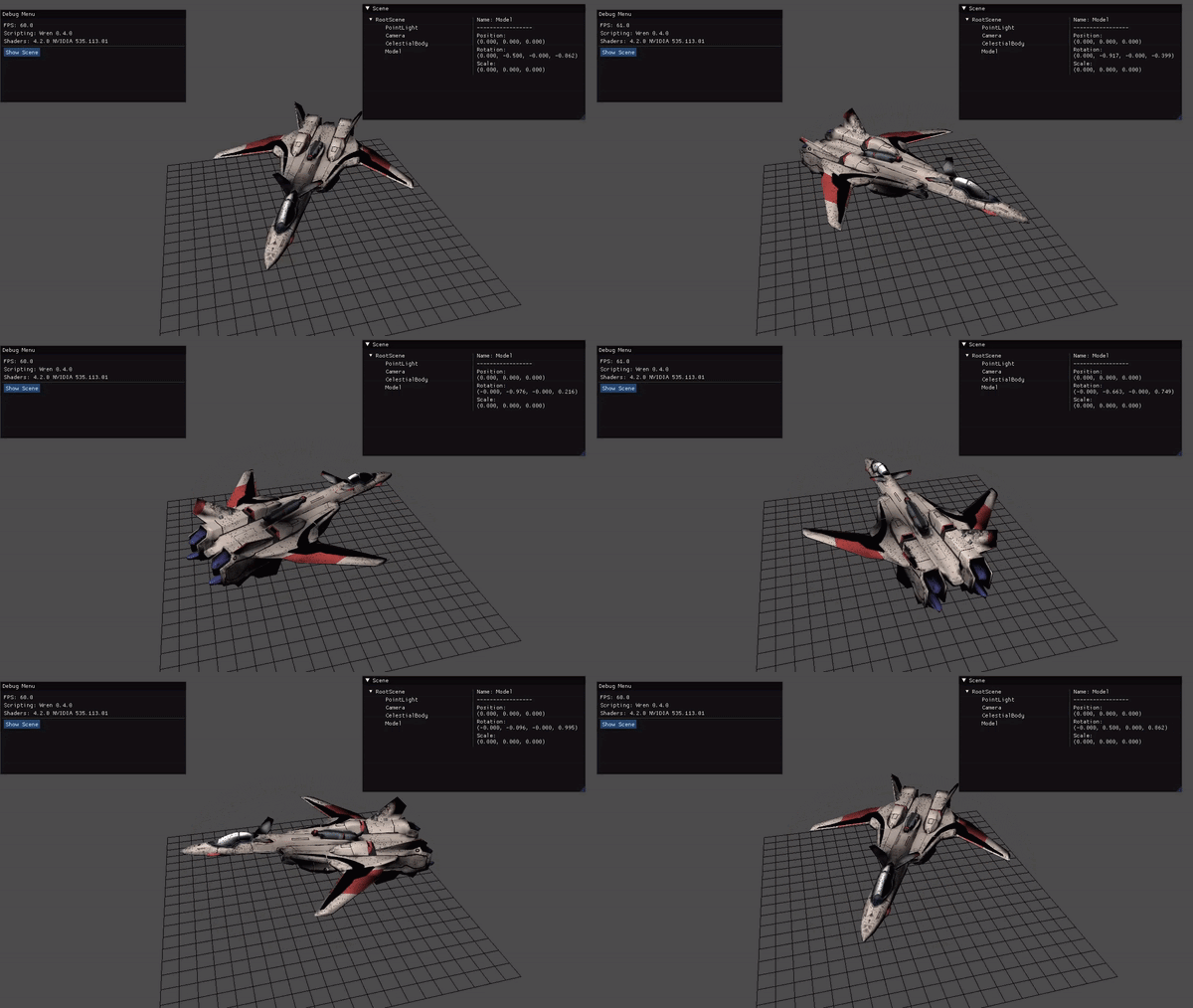
A WIP engine written in C++ and GLFW3 + glad.
It has a forward-rendered PBR pipeline with model loading support.
It has a scene graph implementation that can load scene objects from flatbuffers or via the Wren scripting language.
Wren bindings allow for object movement.
I've designed a control box for a robot cell that contained the pneumatics and I/O needed to automate the
production of medical implantable circuits. The cell merges lay-up and electrical test, replacing two manual workstations and doubling capacity for that operation.
I've also written the program for the robot that executes the motions of the process, using vision to find parts and merge them.
Additionally, I've designed and 3D-printed various tools, fixtures and prototype wrists used in the process.
A paging system I have designed from the ground up to notify the user of
specific events. I’ve designed the circuit around an arduino feather m0
micro-controller to be able to activate a vibration motor and turn on an LED.
I’ve designed the board layout in AutoCAD and the pager enclosure in
SolidWorks. I’ve written the arduino program using a custom protocol that
would allow for transmitters to single out certain pagers if need be.
The pagers went into use on the production floor and greatly improved manufacturing yield.
A procedural generation library I originally started developing in order to learn data structures
like quad trees for LOD and generators such as perlin noise. It quickly evolved as
I dove deeper down the rabbithole of planetary generation.
I began porting it to Godot via gdextension to leverage node graphs as a
means to generate terrain.
A measurement tool written in C++ with OpenCV and GLFW that takes a live feed from any
GigE Vision camera and lets the user take point-to-point measurements and save screenshots
and measurement data. It runs in production on Linux in place of manual gauge measurements.
I wrote a custom rendering engine so the real-time overlays run on low-spec hardware. It
replaced discontinued metrology hardware in a hazardous area where commercial systems were
impractical and cost up to 10x as much, and it ended the need for outsourced inspection.
A microkernel operating system for the Raspberry Pi 4, with its own boot code, EL3 secure monitor,
kernel, drivers, and C library. It runs on Pi 4 hardware and in QEMU, and boots to a graphical desktop
with USB keyboard and mouse. Still in active development.
The kernel is C and ARM assembly: higher-half mapping, MMU-isolated user processes, page and slab
allocators, a timer-driven scheduler, and synchronous port-based IPC with shared memory. The file system,
input, and graphics run as separate user-space services in C++, on drivers I wrote for PCIe, xHCI USB,
eMMC/SD storage, and the framebuffer. The desktop shell (windows, taskbar, start menu, file browser) is
drawn by a custom software rasterizer, with Dear ImGui for widgets and FatFs for the file system.